
If you can't leave him, it isn't because you're weak, and it isn't because something is wrong with you. You're caught in a cycle that researchers mapped almost fifty years ago: the tension, the storm, then the apology that brings back the man you fell in love with, along with just enough hope to keep you there. Seeing the cycle clearly is the first step out of it.
You stay out of his way, you don't bring up the thing you wanted to bring up, and you try to head off whatever might be coming. Maybe you say something to test the mood so you'll know for sure, because you've learned not to trust yourself.
The storm comes anyway.
After it's passed, he's a different man. He apologizes, he cries, he says it will never happen again, and then he brings flowers, books a trip, and becomes the man you first fell in love with. You believe him, or at least part of you does, while the other part is too tired to fight.
Then a few weeks go by and the cycle starts over.
What you're living in has a name, and it has been documented since 1979. You aren't crazy and you aren't alone.
One thing before we go on. If you're afraid for your physical safety, that's beyond what this article covers. The National Domestic Violence Hotline is available 24/7 at 1-800-799-7233, or text START to 88788. They can help you right now.
How the cycle works
A psychologist named Lenore Walker studied women in abusive relationships and noticed that the abuse wasn't random. It moved in phases that repeated, and she named four of them.
Phase one: tension building. You can feel a change in the atmosphere of the house. He gets irritable, withdrawn, and critical, picking fights about small things or going silent for hours. You start walking on eggshells, watching his face for clues and managing every interaction. You tell yourself that if you can just get this dinner right, just say the right thing, just be a little quieter, the explosion can be avoided. Sometimes it can, but often it can't.
What you're seeing is his defenses starting to rise. Something has triggered feelings of shame, inadequacy, or fear in him, feelings he can't tolerate, and the defense system kicks in to keep them buried. The irritability and withdrawal are the early stages of that protection. He hasn't decided to act this way, the system has decided for him, and by the time you notice the change, the defense is already running. The explosion to come is the system protecting him from whatever he's refusing to feel, and the pressure must find a release.
Phase two: the incident. The release can be verbal, emotional, or worse yet, physical. It can be rage and yelling, the silent treatment, or sulking that lasts for days. It can include accusations, name-calling, and threats, or punching walls and breaking things. Whatever form it takes, this is the explosion the tension was building toward.
Underneath, the internal pressure had reached a point he could not contain, and he has to discharge it or the part of him beneath the defenses will collapse. The brain treats this as a survival event. If the feelings he's been refusing to feel break through, the self-image he's built his whole life around shatters, so it's better to explode outward at you than implode inward at himself. He releases the pressure where it's safe for him to release it: on you, on the children, on whoever is closest. The release isn't aimed at you because of anything you did, it's aimed at you because you're there, and that was your only crime. The discharge is what matters to the system.
Phase three: reconciliation, sometimes called the honeymoon. He apologizes, and the apology often feels real to you. He cries and says he doesn't know what came over him. He explains it away with stress at work or childhood trauma, blaming himself, blaming circumstances, blaming you, sometimes all three in the same conversation. He swears it will never happen again and becomes the man you fell in love with, attentive, romantic, and generous. He brings gifts, plans dates, and looks at you the way he used to. Your body relaxes and you remember why you stayed.
This phase is harder to understand than the others, because from the outside it makes no sense. He just exploded and attacked you, and now he's standing in the kitchen humming, asking if you want to go to dinner. He cannot understand why you're still shaken. From his point of view the storm passed, the pressure released, and he feels good, so he can't grasp why everyone else is shell-shocked.
The discharge worked. The pressure that had built up is gone and he no longer feels bad about himself, which is why your reaction confuses him. From his side, the bad feeling left when he expelled it, and he doesn't see that he expelled it onto you.
With the pressure gone, he has temporary access to softer parts of himself, the parts that can be loving and generous. The system isn't currently protecting him, so you're seeing the real man underneath, the man you fell in love with, the man who only shows up here, in this brief space between rounds.
The reconciliation also serves a second function. He needs to repair, not because he loves you, but because if he doesn't, his self-image as a good man cannot survive the evidence of what he just did. So he makes the apology elaborate, brings the flowers, plans the trip, and behaves so well during the calm that the incident gets relabeled in his mind as an aberration instead of part of who he is. He probably doesn't even know that's what he's doing, because the system is just protecting itself. You become the building material his self-image rebuilds itself with, and your tolerance is the cement.
Once the repair is complete, the system resets. The next time something touches the wound, a comment, a setback at work, a moment of feeling small, the pressure will start building again. The honeymoon isn't healing, it's maintenance.
Phase four: calm. This is the good period. The tension is gone, he's warm, and the house feels safe. You let your guard down and start to doubt your own memory of how bad the incident really was. Maybe you overreacted, maybe it wasn't that bad, maybe this time is really different.
Underneath, the system is at rest. The pressure has been discharged, the repair is complete, and nothing is currently triggering the defenses, so they aren't running at full force. He has more access to softer parts of himself in this phase than in any other, and that access is real. He genuinely is the man you see during this period.
What's also true is that nothing has changed. The feelings he cannot tolerate are still buried, the defense system is still in place, and the wound is still untouched. The whole architecture is just dormant, and as soon as something triggers it again, and something will, the cycle starts at phase one and runs through to phase three again. Phase four isn't the end of the cycle, it's the pause between rounds.
The cruelest part of this phase is that it does to your memory what the honeymoon did to your forgiveness. The further you get from the last incident, the harder it is to hold onto how bad it was. Time softens the edges and the calm rewrites the story. You start to wonder if you imagined how scared you were, if you exaggerated to your sister, your therapist, yourself, if maybe the relationship is really fine and you've been the dramatic one.
That isn't your judgment failing, that's the cycle doing what it's built to do. The calm is engineered, by the system itself, to make the incidents forgettable. If you remembered them clearly during the calm you would leave, and the fact that you can't is a feature of the loop, not a flaw in your perception.
Then phase one starts again.
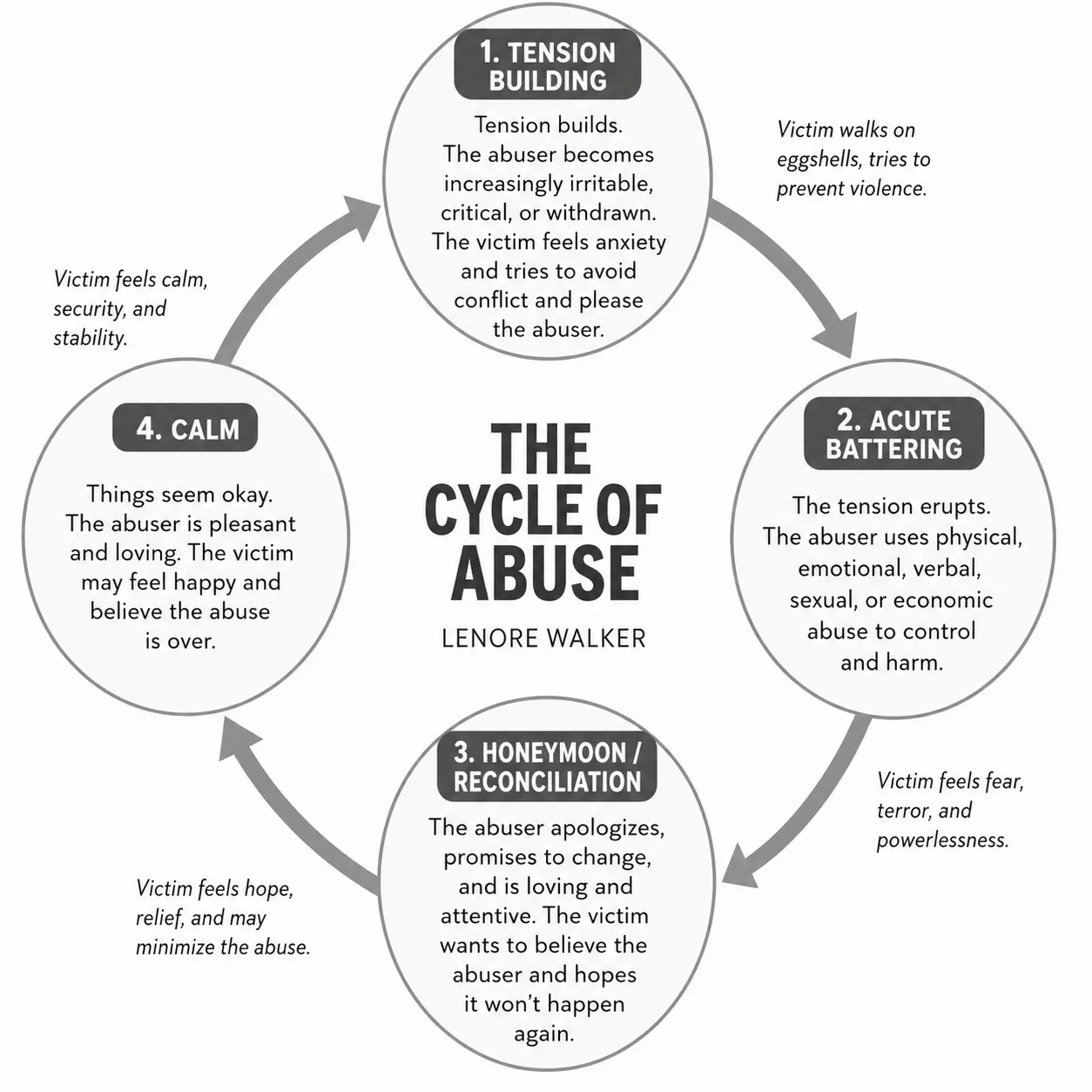
The trap inside the cycle
Here is what makes the cycle so hard to leave. The honeymoon phase is real. He really does become the man you fell in love with, and the good times aren't performances or strategy, at least not in the way you'd think. The man who apologizes and brings flowers and looks at you with love isn't faking it in that moment. He's regulated, the pressure is off, and he has access to a softer version of himself while the cycle is in that phase.
That's why you can't leave. If he were always cruel you'd be gone by now, and so would anyone. The reason you're still here is that he isn't always cruel. He's intermittently wonderful, and intermittent reward is one of the strongest forms of conditioning that exists.
Casinos use this. Slot machines pay out just often enough to keep you pulling the lever, and your brain releases dopamine when you don't know if the next pull will be the win. The unpredictability is the hook. If the machine paid out every time you'd get bored, and if it never paid out you'd quit, so the intermittent payout is what makes it impossible to stop.
Your relationship is doing the same thing to your nervous system. The good moments are real, but they're also the mechanism that traps you. Every honeymoon phase resets your hope, every calm period rewrites your memory of the incident, and by the time the next tension is building, you've half-convinced yourself the previous explosion didn't happen the way you remember it.
This isn't a flaw in your character, this is how brains respond to intermittent reward. Anyone in your situation, with your nervous system, would be having the same experience. You aren't weak for staying. You're caught in a system specifically designed by evolution to keep you reaching for the next payoff.
Why you can't just leave
This is the part that confuses everyone outside the relationship, and often confuses you too. If he's hurting you, why don't you just go? Friends and family ask, and you ask yourself, sometimes nightly. The answer isn't weakness, but it isn't love either. The answer is that the cycle has bonded you to him in a specific way that researchers have a name for.
It's called trauma bonding.
It happens in cycles like this one and almost nowhere else. The combination of high-stress incidents and intense reconciliations creates an attachment that's chemically different from the bond in healthy relationships. Your nervous system doesn't just love him, it needs him to feel safe.
Hostages experience the same thing, and so do cult members and children who grow up with abusive parents and stay loyal to them as adults. Trauma bonding isn't a character flaw, it's a survival adaptation that gets activated when you're hurt by someone you can't escape and can't stop loving. Your body figured out how to live inside an impossible situation, and the fact that you adapted is evidence of how strong you are, not how weak.
During phase two, your body floods with cortisol and adrenaline and your fight-or-flight system goes into overdrive. Then phase three arrives, he's loving and apologetic, and your body floods with relief chemistry: oxytocin and dopamine, the same chemicals released when bonding with a baby or falling in love. The relief is so intense that it gets associated with him, and he becomes both the source of the threat and the source of safety.
Over time, your nervous system can't separate the two. The man who hurt you is also the only one who can make you feel safe again, so you reach for him because his body is the one your body learned to feel safe with. The bond is real, and it's also the trap.
This is why you go back, why you defend him to people who try to help, and why you can't seem to follow through on leaving even when you know you should. Your brain isn't reasoning about whether to stay. Your nervous system is reaching for the only safety it knows.
The hard truth is that the bond doesn't break by itself, but knowing it exists changes things. You stop blaming yourself for not leaving, you stop calling yourself weak, and you start to see what your body has been doing to survive. From there, real choices become possible. Not easy, but possible.
How the cycle changes over time
If the cycle stayed the same forever, that would be one kind of relationship. Unfortunately it doesn't, and it accelerates.
The tension-building phase gets shorter, so what used to take months now takes weeks, maybe days. The incidents get worse. What used to be an argument becomes a yelling match, the yelling match becomes throwing things or shoving, and eventually it becomes physical abuse. The honeymoons get shorter and less convincing, where he used to spend a week being attentive and now it's an evening, and the calm period shrinks until it disappears entirely.
You may reach a moment when you realize the cycle has collapsed into just tension and incident. The honeymoon stopped happening, the calm period went away, and he doesn't bother apologizing the way he used to. He's just irritable, then exploding, then irritable again. By then you've been in the relationship for years and your sense of what's normal has been remade. You have to remember what other relationships were like, because this one has rewritten your baseline.
If your cycle has accelerated, that's not a sign that things are getting worse before they get better. That's the predictable trajectory, and the cycle does this on its own. Without massive intervention, it doesn't reverse.
When his "change" is just phase three
Most women miss this part until someone tells them. You may have already lived through what looked like real change. He went to therapy, stopped drinking, read a book, cried and made promises, and things were different for a while. You thought you had your real man back.
Then the cycle returned.
That wasn't change. That was a long phase three followed by a long phase four, the cycle running on a slower clock for that period. It came back because it was never broken. Genuine change in someone with this pattern is rare and requires three things to line up at once:
- A crisis that cracks his defenses open
- Real and skilled help
- A sustained decision over years to do the work
Most men in this pattern never have all three, and almost none of them have the third.
The change you experienced was the cycle in a longer rhythm. The longer rhythm fooled you because it gave you more good time and made the bad seem like the exception. When the bad came back, you blamed the timing or the stress or yourself, and you didn't see what it really was: the cycle starting over.
If you've been through this loop more than twice, the next "change" he offers is also part of the pattern. You can't out-hope a cycle.
Not every relationship looks the same
Walker's four phases describe a common pattern, but not every abusive relationship follows it exactly. Some men skip the honeymoon entirely, exploding and never apologizing, so the cycle for them is just tension and incident. The reason their partner stays isn't the honeymoon but other things: financial dependence, fear, isolation, children, religious beliefs, or the idea that this is what relationships are.
Some men live in a permanent state of low-grade tension and never fully blow up. The whole relationship is one long phase one, with small daily incidents that never crescendo, and the partner stays because the relationship never gets bad enough to justify leaving, even though the slow accumulation is wearing her down.
Men cycle on different rhythms, yearly, monthly, some daily, and many men have multiple cycles running at once, one around money, one around sex, one around their family of origin.
If your relationship doesn't match Walker's four phases perfectly, that doesn't mean you're not in an abusive cycle. The underlying mechanism is the same: behavior that hurts you, followed by some form of release that draws you back in, followed by behavior that hurts you again. Whatever the shape, that's the loop.
What this means for you
Once you see this cycle, you can't unsee it, and that's both the gift and the cost.
The gift is that the next time he apologizes, brings flowers, and swears change, you'll know what phase you're in. The honeymoon won't work the same way it used to, because your brain will register it as phase three instead of evidence that things are different. You may still feel the warmth and still want to believe him, but part of you will know what's coming next.
The cost is that you can't go back to not knowing. The next time the tension starts building, you won't be able to tell yourself the last incident was an exception. You'll see it for what it is, your nervous system will register what's coming, and the hope will start to feel different.
That difference is what makes leaving possible. Not easy, but possible.
You've been hoping for years that he'll change, and the cycle is one of the things keeping that hope alive. When you see the cycle clearly the hope shifts, not because you stop loving him, but because you stop confusing the cycle for the truth. The man you fell in love with does come back during phase three, and that's real, but he doesn't stay because he can't.
What you're in isn't a relationship that has a cycle. The cycle is the relationship, all of it. The good moments and the bad ones are both parts of the same loop, and you can't have one without the other.
Once you can see it, you can decide what to do with it.
A final word. Leaving is often the most dangerous time in an abusive relationship, so please don't do it alone or on impulse. The National Domestic Violence Hotline (1-800-799-7233, or text START to 88788) can help you make a safety plan first. Coaching isn't the right first step if you're in active danger. Reach out to them or a licensed professional before anything else.